If you searched for linklater meaning, the simplest answer is that Linklater is primarily a surname rather than a standard English word or widely recognized piece of internet slang. The name has Scottish roots, especially in Orkney, and historically developed from place names in that region. Modern searches can be confusing because people also type “link later” as two words when talking about connecting, meeting, or sharing something at another time.
Understanding the difference matters because capitalization and spacing completely change the interpretation. “Linklater” usually points to a family name, a person, or a geographic name. “Link later,” by contrast, is an ordinary phrase used in casual conversation. This guide explains the Linklater meaning, surname origin, likely Old Norse roots, pronunciation, modern uses, and the easiest ways to identify what someone means from context.
What Does Linklater Mean?
The Linklater meaning is most accurately understood as a Scottish habitational surname. A habitational surname originally identified a person by the place they came from or lived near. Family-history sources connect Linklater with places of the same or closely related name in the Orkney Islands, including locations in South Ronaldsay, North Sandwick, and North Ronaldsay. That makes Linklater a geographic family name rather than a descriptive English vocabulary word.
In everyday use, Linklater usually functions as a proper name. You may encounter it in genealogy records, biographies, film credits, academic references, social profiles, or local place names. One of the best-known modern examples is filmmaker Richard Linklater, whose surname helps explain why many U.S. searchers recognize the word even if they do not know its history. Context usually makes the intended meaning clear within a sentence.
Quick answer: Linklater is primarily a Scottish surname connected with Orkney, not a standard slang expression.
Where Does the Linklater Name Come From?
The Linklater surname is strongly associated with Orkney, a Scottish island group with deep Norse linguistic and cultural influence. Reference sources describe the surname as deriving from local place names rather than from an occupation or personal characteristic. This type of naming was common historically: once a person moved away from a location, the place name could become a convenient way to identify that individual and, eventually, their descendants.
For readers researching the Linklater meaning, the etymology provides another useful clue. Sources commonly trace the older name to Old Norse elements represented as lyng, referring to heather, and klettr, referring to a rock or rocky outcrop. The name therefore has a landscape-based origin associated with the physical character of a place. Historical spelling naturally changed as the surname passed through different records and generations.
| Element | Associated Meaning | Connection |
|---|---|---|
| Linklater | Scottish surname | Associated with Orkney |
| Lyng | Heather | Old Norse name element |
| Klettr | Rock or rocky outcrop | Old Norse name element |
| Linkletter | Related spelling | Seen as a surname variant |
The history therefore connects the Linklater name meaning with geography rather than an occupation, personality trait, or modern internet expression.
Is Linklater a Surname or Slang?
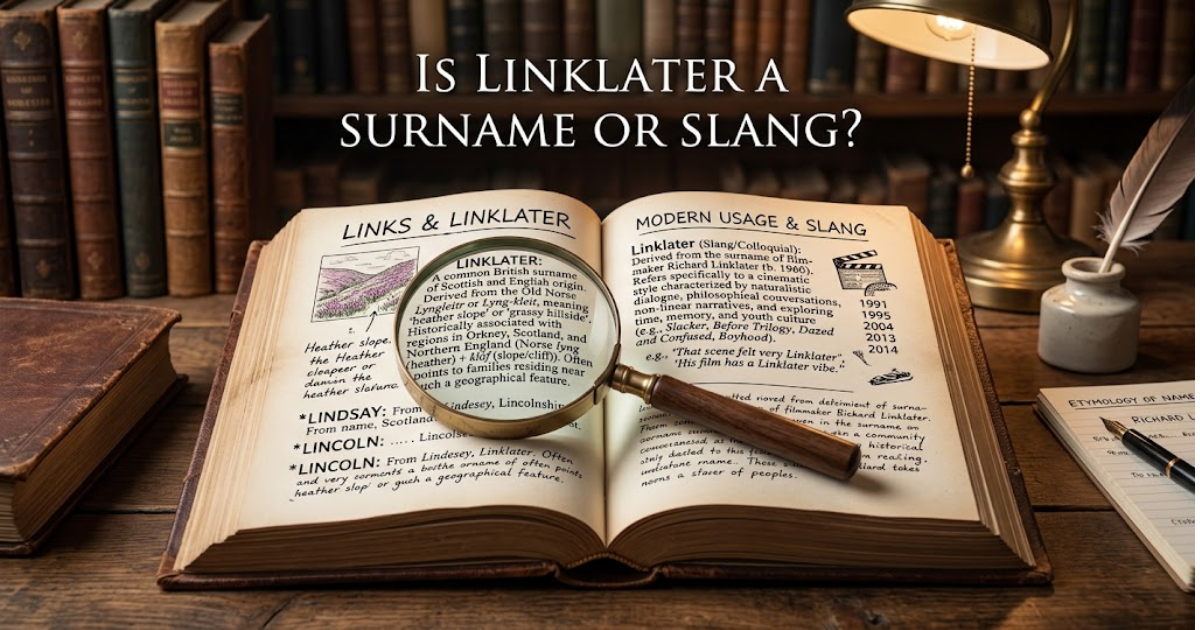
A common source of confusion is whether Linklater is internet slang. Current dictionary and surname references treat Linklater as a proper surname, not as an established slang term. Some newer websites discuss “linklater” because users may combine the two words while typing messages or searches, but the combined spelling does not automatically become a recognized slang expression. Capitalization, spacing, and surrounding words remain the best clues to the intended meaning.
The distinction is especially useful in texts, social media, and search queries. If someone writes, “We can link later,” the phrase simply means to connect, meet, talk, or exchange something later. If a sentence says, “Linklater directed the film,” the word clearly functions as a surname. Search results can address both interpretations, but the two expressions should not be presented as though they share the same linguistic origin.
| Expression | Most Likely Meaning | Example |
| Linklater | A surname or proper name | Richard Linklater |
| link later | Connect or meet later | We can link later tonight. |
| link up later | Meet or reconnect later | Let’s link up later. |
| link it later | Add or send a hyperlink later | I’ll link it later. |
This distinction is important when explaining linklater meaning accurately because users may arrive with different contexts in mind.
What Does “Link Later” Mean in Text or Conversation?
When written as two words, “link later” is a straightforward modern phrase. The verb “link” can mean connect, join, or establish contact, and in informal conversation it can also refer to meeting up with someone. Adding “later” postpones that action. Someone might write, “I’m busy now, but we can link later,” meaning they intend to reconnect or meet after the current moment rather than immediately.
The phrase can also describe digital actions instead of meeting in person. For example, “I’ll link it later” may mean someone will add or send a hyperlink at another time. “I’ll link you later” could refer to connecting two people, depending on the conversation. Because English uses “link” in several ways, surrounding words matter. The combined spelling “linklater” should not automatically be assigned all of these meanings.
Common examples include:
- “Can we link later?” — Can we meet or talk later?
- “I’ll link the source later.” — I will add the hyperlink later.
- “Let’s link up after work.” — Let’s meet after work.
- “I’ll link you with my manager.” — I will connect you with another person.
These examples show why spacing is essential when interpreting the phrase.
How Do You Pronounce and Spell Linklater?
Linklater can be approximated in American English as “LINK-lay-ter.” Pronunciation can vary between speakers and families, so a person’s own pronunciation should take priority. In writing, the surname normally begins with a capital L because it functions as a proper noun. When referring to connecting at another time, however, “link later” should remain two separate words rather than being written as one.
Spelling also matters when researching Linklater family history. Linklater and Linkletter occur as related surname forms, but similar spelling should not automatically be treated as proof that two individuals belong to the same family line. Historical documents commonly contain surname variations. Researchers should therefore compare dates, locations, relatives, census information, and original records rather than using spelling alone to establish a genealogical connection.
Quick Spelling Checklist
-
Use Linklater when referring to the surname.
-
Capitalize the first letter of the surname.
-
Use link later when referring to connecting at another time.
-
Do not assume “linklater” is established texting slang.
-
Check historical spelling variants carefully during genealogy research.
Where Might You See the Name Linklater?
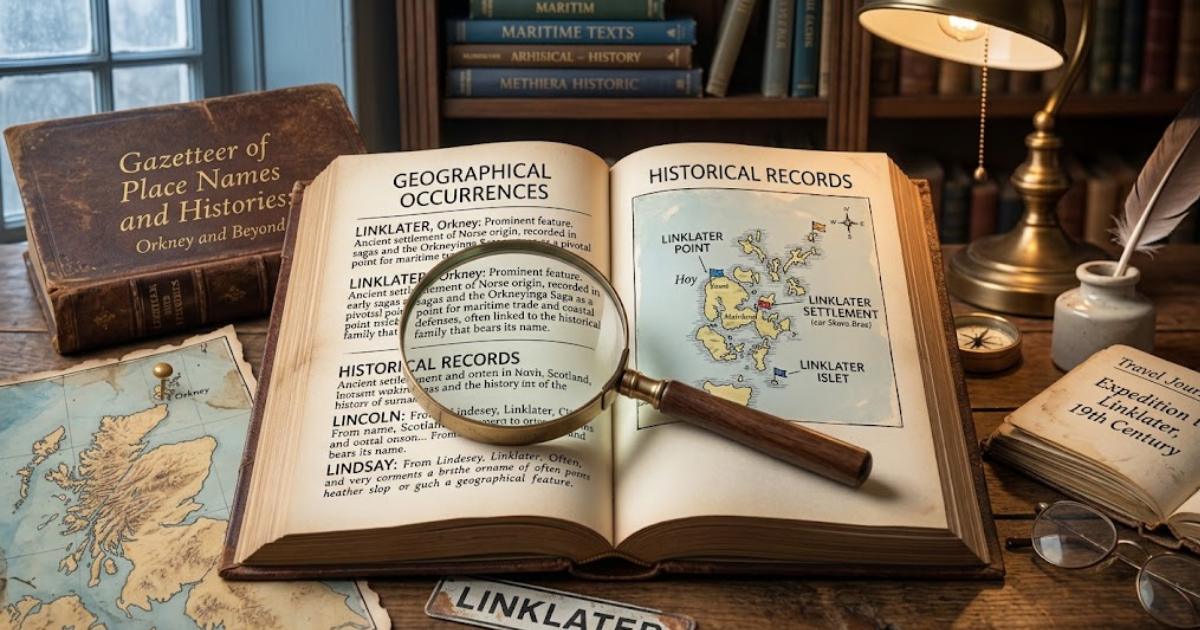
You are most likely to see Linklater in contexts involving names, history, entertainment, genealogy, or geography. A biography may identify someone with the surname. A family-tree database may discuss the Linklater surname origin. A map or historical document may use the name for a place associated with Orkney. In those contexts, there is usually no hidden abbreviation, coded message, or special social-media definition that needs to be decoded.
The fastest way to understand an unfamiliar use is to examine the sentence around it. Ask whether the word identifies a person, place, or family. Then test whether separating it into “link later” makes the sentence sound more natural. If the writer discusses meeting, messaging, sharing a URL, or reconnecting, the two-word phrase is more likely. If it appears beside a first name, biography, or title, the surname interpretation is stronger.
Use this simple process:
- Check capitalization. “Linklater” suggests a proper name.
- Check spacing. “Link later” represents two ordinary words.
- Read the surrounding sentence. Look for clues about people, places, meetings, or URLs.
- Identify the topic. Genealogy and biographies usually indicate the surname.
- Avoid inventing slang definitions. Use the interpretation supported by context.
Conclusion
The clearest answer to linklater meaning is that Linklater is primarily a Scottish surname associated with Orkney and historically tied to local place names. Its deeper etymology is generally linked with Old Norse landscape terms involving heather and rock. That background explains why the name commonly appears in genealogy, biographies, geographic references, and historical records rather than functioning as a normal English vocabulary word.
At the same time, Linklater should not be confused with “link later.” The two-word expression simply refers to connecting, meeting, sending a link, or performing another connecting action at a later time. Checking capitalization, spacing, and context will usually resolve the difference quickly. For family research, focus on Scottish and Orkney sources; for a text or social-media message, examine the surrounding sentence before deciding what the writer intended.