Temperature plays a crucial role in everyday life — from checking the weather to cooking, science experiments, and industrial processes. However, different parts of the world use different temperature scales, which often creates confusion. The two most commonly used scales are Celsius and Fahrenheit.
If you’ve ever wondered how to convert Celsius to Fahrenheit, why the scales are different, or when to use each one, this detailed guide will explain everything in simple terms.
What Is Celsius?
The Celsius scale is a temperature measurement system used by most countries worldwide. It is part of the metric system and is widely used in science, education, and daily weather reports.
The scale was developed by Swedish astronomer Anders Celsius in 1742. On this scale:
-
Water freezes at 0°C
-
Water boils at 100°C (at standard atmospheric pressure)
Because of its logical structure and connection to the metric system, Celsius is considered easier for scientific calculations.
What Is Fahrenheit?
The Fahrenheit scale is primarily used in the United States and a few Caribbean countries. It was introduced by German physicist Daniel Gabriel Fahrenheit in 1724.
On this scale:
-
Water freezes at 32°F
-
Water boils at 212°F
Fahrenheit offers more gradations between temperatures, which some people believe allows for more precise everyday readings, especially in weather forecasts.
Why Do We Need to Convert Celsius to Fahrenheit?
Temperature conversion is important for many reasons:
1. International Communication
Scientists, travelers, and global businesses often need to translate temperatures between systems.
2. Weather Understanding
If you see a forecast in Celsius but are used to Fahrenheit (or vice versa), conversion helps you interpret how hot or cold it really is.
3. Cooking and Baking
Recipes from different countries may use different temperature scales.
4. Education and Science
Students frequently convert temperatures in physics and chemistry problems.
The Celsius to Fahrenheit Formula
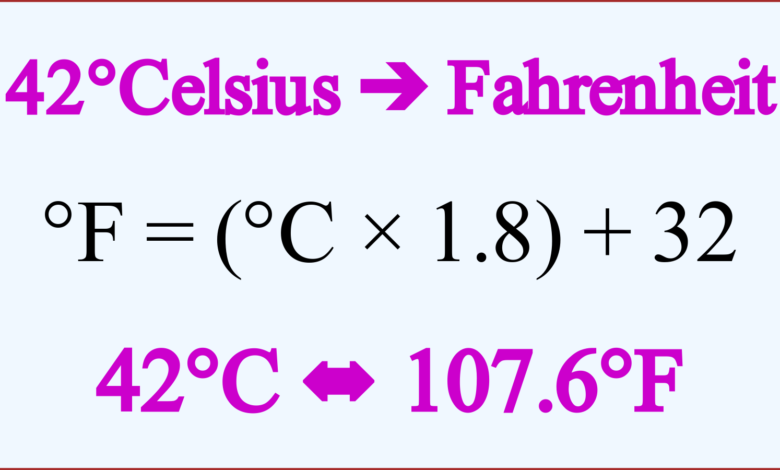
The formula to convert Celsius (°C) to Fahrenheit (°F) is:
°F = (°C × 9/5) + 32
How It Works
-
Multiply the Celsius temperature by 9/5 (or 1.8)
-
Add 32 to the result
This formula accounts for both the different starting points and the different interval sizes between the two scales.
Step-by-Step Conversion Examples
Example 1: Convert 25°C to Fahrenheit
-
25 × 9/5 = 45
-
45 + 32 = 77°F
Example 2: Convert 0°C to Fahrenheit
-
0 × 9/5 = 0
-
0 + 32 = 32°F
Example 3: Convert 37°C to Fahrenheit (Body Temperature)
-
37 × 9/5 = 66.6
-
66.6 + 32 = 98.6°F
Quick Celsius to Fahrenheit Reference Table
| Celsius | Fahrenheit |
|---|---|
| -10°C | 14°F |
| 0°C | 32°F |
| 10°C | 50°F |
| 20°C | 68°F |
| 25°C | 77°F |
| 30°C | 86°F |
| 40°C | 104°F |
This table is useful for quick estimates without doing the calculation.
Understanding the Difference Between the Two Scales
Different Zero Points
Celsius uses the freezing point of water as zero, while Fahrenheit starts at 32 degrees for freezing.
Different Degree Size
A single degree in Fahrenheit is smaller than a degree in Celsius.
-
1°C equals 1.8°F
Scientific vs Everyday Use
-
Celsius is standard in science and most countries
-
Fahrenheit is commonly used for weather in the U.S.
When Is Celsius More Useful?
Celsius is particularly helpful in:
-
Scientific research
-
Laboratory experiments
-
International travel
-
Global weather reports
Its base-10 structure aligns perfectly with the metric system, making calculations simpler.
When Is Fahrenheit More Useful?
Fahrenheit is often preferred for:
-
Daily weather tracking in the U.S.
-
Situations where finer temperature distinctions are helpful
-
Household thermostats in certain regions
Because the scale spreads typical outdoor temperatures across a wider range, some people find it more intuitive for comfort levels.
Mental Math Trick for Quick Conversion
If you don’t want to use the exact formula, you can estimate:
Double the Celsius temperature and add 30
This gives a rough approximation.
Example:
20°C → (20 × 2) + 30 = 70°F (actual value is 68°F)
It’s not exact but useful for quick everyday estimates.
Real-Life Applications of Celsius to Fahrenheit Conversion
Weather Forecasting
Travelers often convert temperatures to understand climate conditions better.
Healthcare
Body temperature readings may appear in either scale depending on the country.
Engineering
Temperature conversions are common in manufacturing and design.
Food Industry
Oven temperatures and storage requirements may require conversion.
Common Mistakes to Avoid
-
Forgetting to Add 32
Many people multiply by 9/5 but forget the final step. -
Mixing Up the Formula
The reverse conversion (Fahrenheit to Celsius) is different. -
Rounding Too Early
Round only at the end for more accurate results.
Why the World Has Two Temperature Systems
Historically, different scientists developed their own measurement systems before global standardization existed. Over time:
-
Most countries adopted Celsius due to the metric system
-
The U.S. kept Fahrenheit because it was already widely used
Today, both scales coexist, making conversion skills valuable.
The Science Behind Temperature Measurement
Temperature measures the average kinetic energ of particles in a substance. The higher the temperature, the faster the particles move.
Both Celsius and Fahrenheit measure the same physical property — they simply use different reference points and increments.
Tips to Easily Remember the Formula
-
Think: Multiply, then add 32
-
Remember freezing point: 0°C = 32°F
-
Remember body temperature: 37°C ≈ 98.6°F
Using these reference points helps you estimate quickly even without calculations.
Conclusion
Understanding Celsius to Fahrenheit conversion is a practical skill that makes it easier to interpret weather, follow recipes, travel, and work with scientific data.
While the formula may seem technical at first, it becomes simple with practice. Knowing a few key reference points and using quick estimation tricks can help you convert temperatures confidently in everyday situations.
Whether you’re a student, traveler, professional, or simply curious, mastering this conversion helps you navigate a world that still uses two different temperature systems.
FAQs
What is the easiest way to convert Celsius to Fahrenheit?
Use the formula (°C × 9/5) + 32 or double the Celsius value and add 30 for a quick estimate.
Why does the Fahrenheit scale start at 32 for freezing?
It was based on historical reference points chosen by Daniel Fahrenheit, including brine mixtures and body temperature estimates.
Which countries use Celsius?
Almost all countries worldwide use Celsius, especially those following the metric system.
Is Celsius more accurate than Fahrenheit?
Both are equally accurate; they just use different increments. Fahrenheit provides smaller steps, while Celsius is simpler for calculations.
What is normal room temperature in Fahrenheit?
Typical room temperature is about 20–22°C, which equals 68–72°F.
Why do scientists prefer Celsius?
Because it aligns with the metric system and is directly related to water’s freezing and boiling points, making calculations easier.